Cardiovascular Drift (2026)
for violin and piano - 7 min
As a distance runner, I track and analyze various statistics over the course of my long runs including my heart rate, the cadence of my steps, and my respirations to name a few.
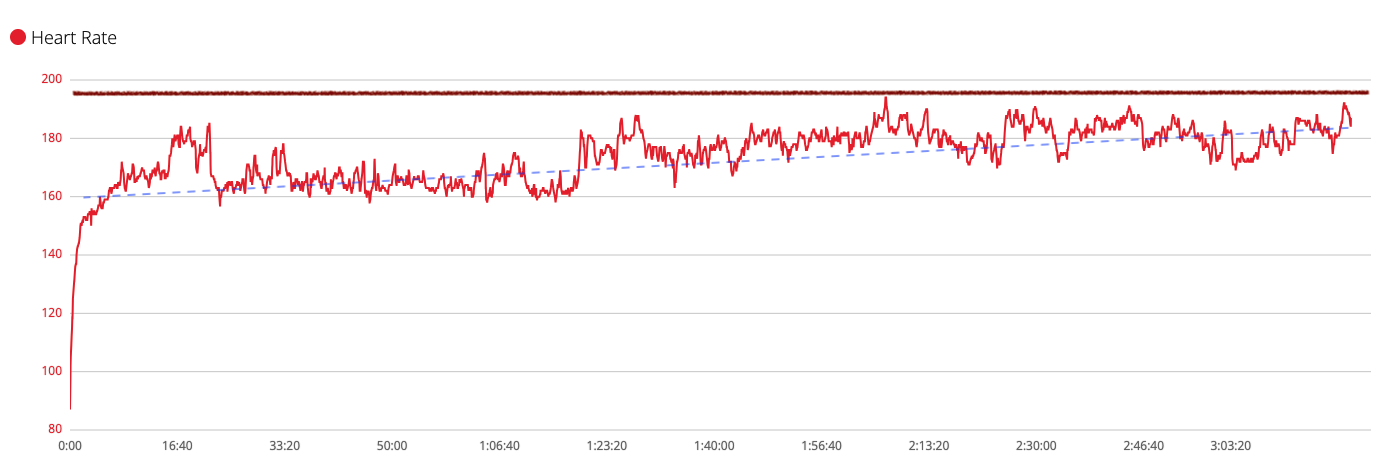
One occurrence that I have grown intrigued by has been Cardiovascular Drift, which is the progressive increase in heart rate during prolonged exercise. Despite a sustained, seemingly steady effort level, the heart rate will slowly rise as fatigue sets in. Below is a graphical representation of my heart rate over the course of a marathon, the dotted blue line showing a gradual increase in average heart rate during the course of over three hours despite a relatively low standard deviation of pace.
This relationship between perceived effort and underlying strain influenced my writing of this piece and my treatment of both rhythmic dissonance and clarity. These two concurrent yet differing streams have a unique way of working together and fighting each other.
Additionally, the cardiovascular drift phenomenon exposes the athlete’s limit. The slow-creeping heart rate approaches an asymptote, which represents their maximum heart rate (shown in dark red on the graph). I treat the asymptote relationship as both a rhythmic and pitched motif throughout the piece, including in what I describe as a “performance asymptote,” where the performers must repeat and accelerate material as fast as possible without reaching the moment of failure. In this way, the piece may be ever evolving, producing unique performance outcomes that challenge performers to approach their own limits.